AI answering services for UK tradesmen: what actually works on site
Most advice about answering services is written for offices. This one is written for people whose hands are full, whose phone is in a jacket on the van seat, and whose customers ring at half seven in the morning.
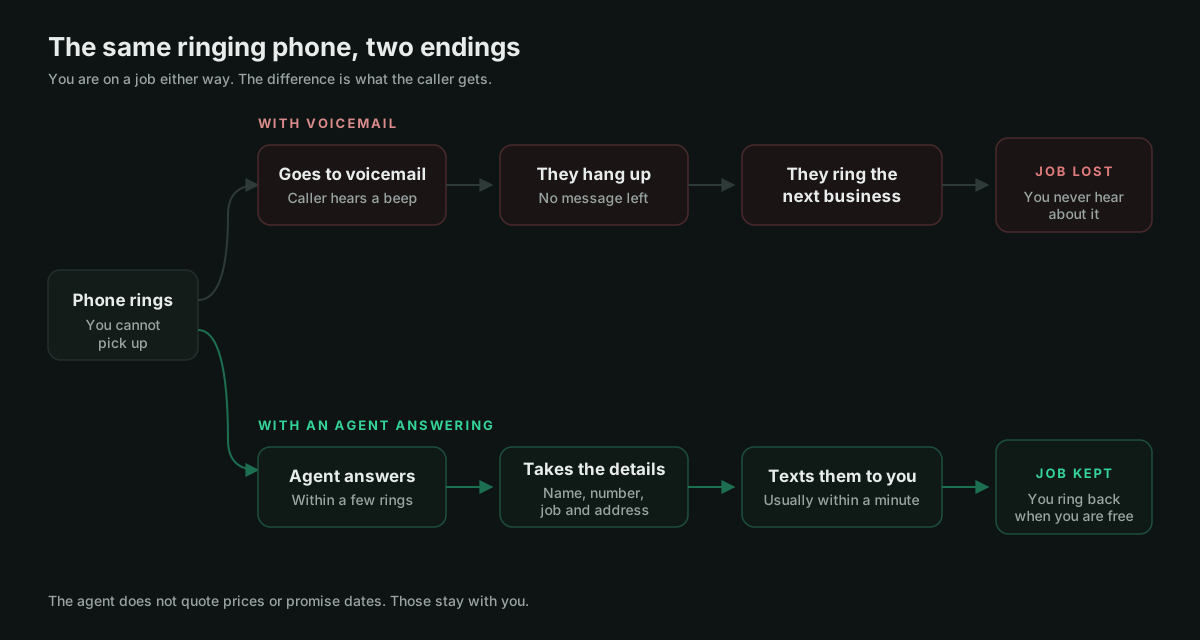
You cannot answer the phone with your hands inside a boiler. That is not a business failing, it is the job. The trouble is that the customer on the other end does not know or care why you did not pick up. They have a leak, a broken tile or a dead socket, and they want somebody today.
What happens next is the expensive part. A lot of people will not leave a voicemail. They ring the next name on their search results. You never find out the call existed, so it never feels like a loss. It just feels like a slow fortnight.
This guide covers what to do about that specifically as a tradesperson in the UK, including the things that trip up services built for American offices.
Your options, cheapest first
There are more than two. Most people jump straight from voicemail to "hire someone", and there is a lot in between.
- Change your voicemail message. Free. Instead of the default beep, record something that tells people what to do: "I'm on a job, text me what you need and where, and I'll ring you back this afternoon." You will get more texts and fewer silent hang-ups.
- Missed call text back. A few pounds a month, or included in many business phone apps. An automatic text goes out within a minute of a missed call. It does not answer anything, but it stops the silence. How missed call text back works.
- An AI answering service. Picks up, has a short conversation, takes the details, texts them to you. Works at three in the morning and on Boxing Day.
- A human answering service. Real people in a call centre taking messages for you. Better at difficult callers, more expensive as volume grows.
- Somebody you know. A partner, a parent, a retired relative. Cheap and personal, until they go on holiday or get fed up.
Work down that list rather than starting at the bottom. If option one fixes it, you have saved yourself a monthly bill.
How an AI service actually works for a trade
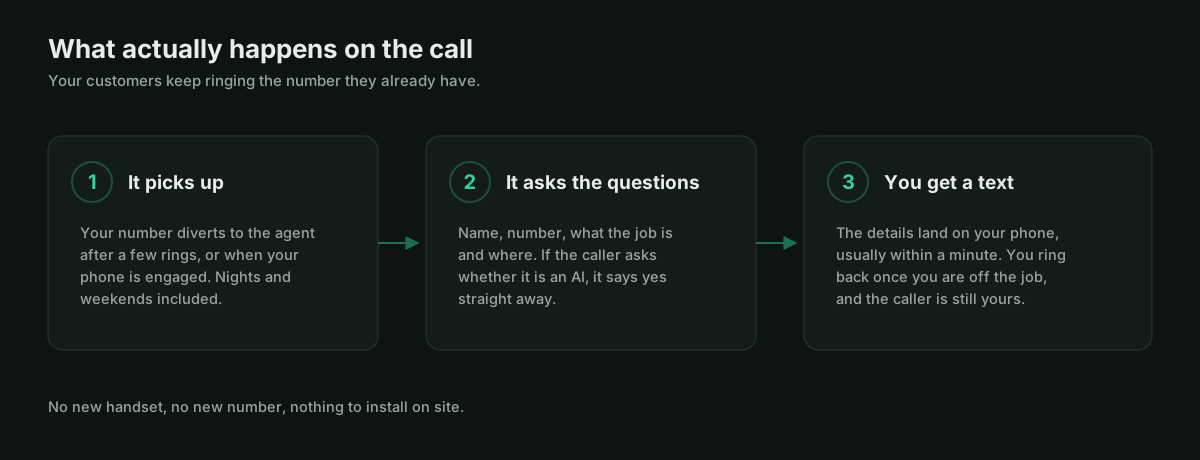
The setup matters more than the technology. Your number stays the same. It is the same number on your van, your website and your Checkatrade listing. When you do not answer within a few rings, or your phone is engaged, the call diverts to the agent instead of voicemail.
The agent gets four things: who they are, their number, what the job is, and where. Then it texts that to you. You ring back at lunch or when you are off the roof, and as far as the customer is concerned somebody picked up and somebody rang back.
Six things to check that office guides never mention
1. Can it take a postcode?
This is the one that catches people out. Plenty of these services were built and tested on American callers, and a UK postcode read out by someone in a hurry is a harder problem than an American zip code. If the agent cannot capture a postcode accurately, you cannot use the lead. Test this first, before anything else.
2. Does it cope with your accent, not a presenter's?
Ring it yourself and speak the way you actually speak, at your actual speed. Then have your most broad-accented mate ring it. If it only works for people who speak like a newsreader, it will not work for your customers.
3. Does it know the difference between a job and an emergency?
A dripping tap and a burst pipe are not the same call. Decide what counts as urgent in your trade, and check the service can pass those straight through to your mobile rather than politely taking a message about a flooded kitchen.
4. Does it refuse to quote?
This matters more than anything else on the list. You cannot price a job you have not seen. If the agent says "that'll be around two hundred pounds" to be helpful, the customer will hold you to it when you turn up and find the joists are rotten. Ask the provider directly what the agent does when a caller asks for a price. The right answer is that it declines politely and says you will confirm.
5. Where does the lead land?
You want a text. Not an email you will read on Sunday, not a notification in an app you installed once. A text, to the phone in your pocket, with the number in it so you can tap to ring back.
6. Can it hear over a compressor?
Not the agent's end, yours. When you ring back from site, nothing matters. But if the service offers a feature where it rings you to patch a caller through, test that in your actual working noise.
What it costs, and whether it is worth it for you
Self-serve AI services start around $29 to $49 a month for a modest allowance of minutes. Done-for-you services, where someone else configures it and fixes it when it goes wrong, cost more, typically a couple of hundred a month. UK human answering services start around £45 a month and climb with volume. I put the actual current prices side by side in the full comparison of AI answering services.
Whether any of that is worth it comes down to one sum, and it is your sum, not an industry average. Count last week's missed calls on your phone. Work out how many were real enquiries, how many you would have won, and what a job is worth to you. The maths is laid out here, or you can put your figures into the calculator on our homepage.
If that sum comes out at £40 a month, do not buy anything. Change your voicemail message and get on with your day.
"My customers will hate talking to a robot"
I hear this from tradespeople more than any other objection, and it deserves a proper answer rather than a sales line.
Some callers will not love it. That is true and there is no point pretending otherwise. But the comparison is not the agent against you. When you are up a ladder, the caller does not get you either way. The comparison is the agent against a voicemail beep.
Given that choice, most people would rather talk to something that asks what the job is and takes their number. And there is a fair argument that it is more respectful than a beep, because at least somebody has written down what they need.
Two rules make the difference between an agent customers tolerate and one that annoys them. It should say yes immediately if someone asks whether it is an AI. And it should never invent a price or a date.
Test it from the van in fifteen minutes
Every service worth considering has a trial. Do not judge it on the website video. Ring it and try to break it:
- Ring from the van with the engine running.
- Give a local street name and a full postcode. Check what comes through.
- Talk over it, the way real people do.
- Ask what it would cost to sort your problem. See whether it guesses.
- Ask if it is a robot. You want a straight yes.
- Then look at the text that arrived. Could you ring that person back and sound like you knew what they wanted?
That last point is the only test that counts. Everything else is detail.
Common questions
Will it understand UK postcodes and accents?
Some do it well and some do not. Many of these services were built and tested mostly on American callers. Test it with your own voice and a few local addresses before you commit to anything.
Can I keep my mobile number?
Usually yes. The standard setup diverts your existing number when you do not answer, so nothing changes for your customers or on your van.
What about existing customers with emergencies?
Most services can pass urgent calls straight through to you. Work out what counts as urgent in your trade and set that up during the trial rather than after.
Do I need to be good with computers?
For the self-serve services, you will be writing the script and testing it yourself, which takes an evening. If that is not for you, a done-for-you service costs more and someone else does that part.
Where I stand
I build and run Pulsemint, a UK answering service for small businesses, so I am not neutral. What I have written here is what I would tell a mate in the trade: start with the free fix, do the sum honestly, and test anything you are considering with your own accent and your own postcodes before you pay for it.
See what I built, or work out what your missed calls are worth first.