Missed call text back: what it is and how to set it up
This is the cheapest useful thing you can do about an unanswered phone, and most businesses can switch it on this afternoon. It is also commonly oversold, so this guide covers what it does not do as well as what it does.
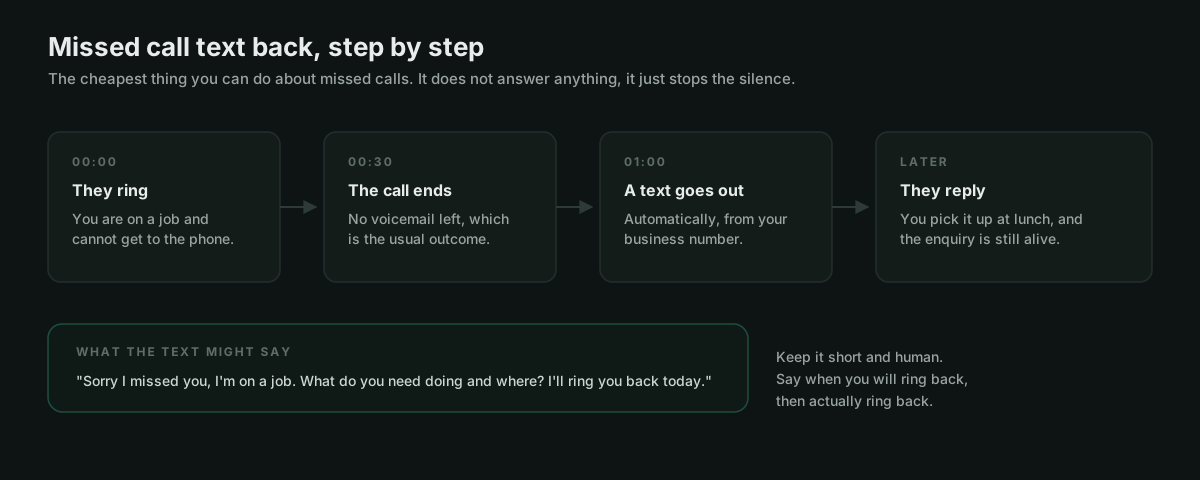
What it actually does
When a call comes in and you do not pick up, the system notices and sends that number a text. Usually within a minute, from your business number, saying something along the lines of "sorry I missed you, I'm on a job, what do you need and where?"
That is the whole thing. It does not have a conversation. It does not collect an address. It does not book anything in.
What it does is turn a dead end into an open door. The caller who was about to ring your competitor now has a message on their phone from a business that clearly exists and clearly wants the work. A good proportion will reply by text rather than carry on down the list, and a text thread is something you can pick up at lunchtime without losing anything.
What it costs
Usually very little, and often nothing extra. It is built into many business phone apps and small business CRM packages. Standalone, expect a few pounds a month plus the cost of the messages.
Check what you already pay for before you buy anything new. A lot of owners are paying for this feature already and have never switched it on.
Writing the message
This is where most people go wrong, usually by sounding like a corporation. Four rules:
- Sound like a person. "Thank you for contacting us. Your call is important" is the tone of a company that does not care. "Sorry I missed you, I'm on a job" is a human being.
- Ask one clear question. You want them to reply. Give them something easy to answer: what do you need, and where are you?
- Say when you will ring back. "Later today" beats "as soon as possible", because the second one means nothing and everybody knows it.
- Keep it short. Two sentences. Nobody reads a paragraph from a number they do not recognise.
Templates you can use
Trades: "Sorry I missed you, I'm on a job. What do you need doing and where? I'll ring you back this afternoon. Dave, Dave's Plumbing"
Salon or clinic: "Sorry we missed your call, we're with a client. If you're after an appointment, text us what you need and a rough day that suits and we'll come back to you within the hour."
Out of hours: "Thanks for ringing, we're closed now but we've got your number. Text us what you need and we'll call first thing. If it's an emergency, [what they should do instead]."
Notice that all three sign off or identify the business. A text from an unknown number with no name gets ignored or reported as spam.
The UK rules, briefly
People worry about this and mostly do not need to. A text replying directly to someone who has just rung you is a service message answering their enquiry, not unsolicited marketing, and those are treated differently under UK rules.
Two things to keep on the right side of it. Keep the message to answering their call, with no offers or promotions bolted on. And do not then add that number to a marketing list and text them again later without their consent, because that is a different thing entirely. If you are unsure, the Information Commissioner's Office publishes guidance on electronic marketing. I am not a lawyer and this is not legal advice.
Where it falls down
Three honest limitations, because this gets sold as a complete solution and it is not one.
It does not get you a lead. You have a phone number and nothing else. No name, no address, no idea whether it is a blocked drain or a full bathroom. If they do not reply, you are no better off than voicemail.
Some people never read texts. Older customers in particular. A text to someone who does not use texts is the same as a voicemail to someone who does not leave them.
It cannot handle an emergency. A burst pipe at ten at night does not want a text saying you will ring tomorrow. They want somebody now, and they will find somebody now.
When to move up to something that answers
Text back is the right first step for most businesses. Move beyond it when one of these is true:
- You are getting replies but still spending your evening playing text tennis to find out what the job is.
- A lot of your calls come outside working hours, when a promise to ring tomorrow loses the job.
- Your missed call number is big enough that a few percent more conversion easily covers a proper service. Work out your number first.
At that point an answering service, AI or human, collects the name, number, job and address so you can ring back already knowing what you are walking into. I have compared the main AI answering services with their current prices, and there is a trade-specific version if you are on the tools.
Do this today, whatever else you decide
Even if you buy nothing, change your voicemail greeting this afternoon. The default message is a wasted opportunity. Replace it with something that tells people exactly what to do: "I'm on a job and can't get to the phone. Text me what you need and where, and I'll ring you back today."
It takes two minutes and costs nothing, and it converts some of the people who would otherwise hang up in silence.
Common questions
What is missed call text back?
An automatic text sent to anyone whose call you did not answer, usually within a minute. It does not answer the call or collect details, it just tells the caller you have seen them.
How much does it cost?
Often nothing extra, because it is included in many business phone apps. Standalone it is usually a few pounds a month plus the texts.
Is it legal in the UK?
A direct reply to someone who just rang you is a service message rather than unsolicited marketing. Keep it to answering their call and do not text them again later for marketing without consent. Check the ICO's guidance if in doubt.
Is it better than an answering service?
It is cheaper and simpler, but it does less. Text back keeps a caller warm. An answering service gets you a usable lead. Starting with text back and moving up is a sensible order.
Where I stand
I run Pulsemint, which sells the more expensive option, so it is worth saying plainly: for a lot of small businesses, text back plus a better voicemail message is enough, and you should try that first. It costs almost nothing and you will know within a fortnight whether it has fixed the problem.
If it has not, see what I built or run your numbers.