What missed calls actually cost your small business
Search this question and you will find a lot of confident statistics, most of them published by companies selling answering services. Mine would be no more trustworthy. So here is how to work out your own number instead, in about ten minutes.
Why the statistics you find online are not much use
You will see claims that businesses miss a certain percentage of calls, or that some share of callers never ring back. Some of those numbers may well be sound. The problem is that almost all of them are published by firms whose business is selling you a solution, the sample is rarely described, and none of them know anything about your trade, your area or your customers.
More importantly, you do not need them. You are carrying the only data that matters in your pocket.
Step one: count, do not guess
Open your call history and count the unanswered calls from a normal week. Not your busiest, not your quietest.
Most owners I speak to guess two or three and find more when they actually look. That gap is the whole reason this problem goes unnoticed. A missed call leaves no trace in your diary, no gap in your schedule and no angry customer. It is invisible, which is exactly why it persists.
If you can, count a second week as well. One week can be a fluke.
Step two: take out the ones that were never going to be customers
Not every missed call is lost money. Go through and cross off the suppliers, the couriers, the wrong numbers, the recruitment agencies and the people trying to sell you solar panels.
Be strict here. This is the step where it is tempting to inflate the figure, and an inflated figure leads you to buy something you do not need. What is left is the number of real enquiries you missed.
Step three: apply a win rate you would say out loud
Of those genuine enquiries, how many would you actually have won?
Not all of them. Some were price shopping. Some wanted a job you do not do. Some were ten miles outside your patch. If you win roughly half the quotes you give, use half. If you are honest and say a third, use a third.
This is the step people skip, and skipping it is how you end up with a scary number that does not survive contact with reality.
Step four: multiply by what a job is worth
Use your average job value. If your work ranges from a £90 callout to a £4,000 installation, use the average rather than the big one, because the calls you miss are not all big jobs.
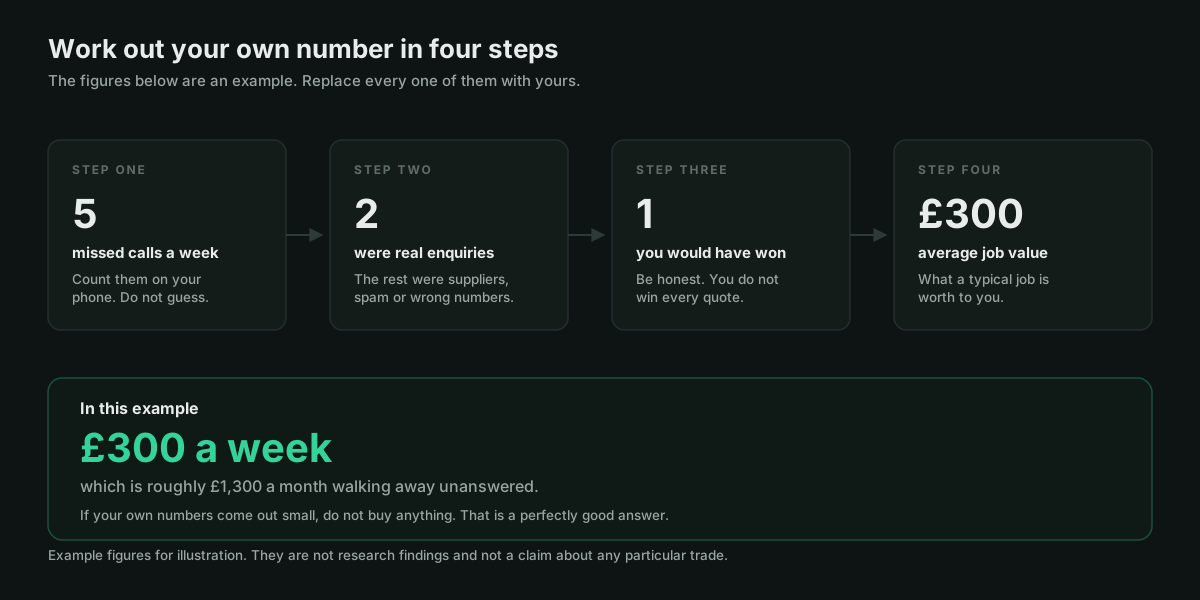
Five missed calls a week, two of them real enquiries, one you would have won, at £300 a job. That is £300 a week, or roughly £1,300 a month.
Multiply your weekly figure by about four and a third for a monthly one. Then sit with that number for a minute, because it is the number that decides everything else.
If you would rather have the sum done for you, the calculator on our homepage does exactly this and will happily tell you the answer is "do nothing".
Three things that make the number bigger than it looks
Once you have your figure, there are three effects worth adding to your thinking. I cannot put numbers on these for your business, but they are real and they all push the same way.
Repeat work
A customer is rarely worth one job. If you win a boiler service, you may get that customer's next three years of servicing, plus the emergency when their radiator goes. A missed call does not cost you one job, it costs you a relationship you never started.
Recommendations
In trades especially, customers come from other customers. The person who never got through does not recommend you to their neighbour, because as far as they are concerned you do not exist.
Out of hours calls are different
Count your evening and weekend missed calls separately. Someone ringing a plumber at seven on a Sunday is usually working down a list, fast, and whoever answers gets the job. Those calls convert at a different rate from a Tuesday afternoon enquiry.
Now decide what, if anything, to do
You have a monthly number. Compare it with what a fix costs:
| Option | Rough cost | Worth it when |
|---|---|---|
| Better voicemail message | Free | Always. Do this today regardless of what else you choose. |
| Missed call text back | A few pounds a month | Your number is small, or you want to test the idea cheaply. |
| AI answering service | From about $29 to £199 a month | Your number comfortably exceeds the monthly cost. |
| Human answering service | From about £45 a month, rising with volume | Your calls are often difficult, emotional or sensitive. |
The honest rule of thumb: if the fix costs more than about a quarter of what you are losing, it is not obviously worth it. If it costs a tenth, it is an easy decision. Anywhere in between, try the free trial and judge it on the leads that actually arrive.
And if your number came out small, that is a real result. Change your voicemail message, spend nothing, and go back to work.
Common questions
How many calls does the average small business miss?
Published figures vary a lot, and many come from companies selling the solution. Your own call history is the only number worth acting on, and checking it takes two minutes.
Do most people leave a voicemail?
Many do not. You can check this for yourself: compare the missed calls in your phone over a week with the number of voicemails you actually got.
Should I count out of hours calls?
Count them, but separately. They tend to be the strongest argument for round the clock cover.
What if my calls are mostly existing customers?
Then your number will be lower, and that is useful to know. Existing customers usually do ring back. New customers often do not.
Where I stand
I run Pulsemint, which sells one of the fixes in that table, so I have an obvious interest in you deciding the number is big. That is exactly why this guide pushes you towards conservative assumptions at every step.
If the sum says do nothing, do nothing. If it says otherwise, compare the options honestly or have a look at what I built.