Answering service for electricians
Pulsemint is an answering service for electricians. When you can't pick up, it answers in your business name, finds out whether the caller has a fault, a quote request or a landlord certificate due, takes their address and details, and texts you a summary within about a minute. It costs £199 a month including up to 50 captured calls, and you can try it free for 14 days with no contract.
Below is what the agent asks on an electrical call, how it handles the difference between a power cut and a fault, and why letting agent calls are worth more than they look.
Pulsemint at a glance
- What it does
- Answers the calls you miss, takes the caller's details and the job, and texts you a summary within about a minute
- Price
- £199 a month including up to 50 captured calls
- Free trial
- 14 day pilot, no card needed
- Contract
- None. Cancel any time.
- Hours
- Every hour of every day, same price
- Your number
- Stays the same. Unanswered calls divert to Pulsemint.
- Setup
- Done for you, about ten minutes of your time
- Coverage
- Anywhere in the UK
Try Pulsemint free for 14 days
Leave your name and email, then pick a time for a 15 minute setup call. No card and no contract. You keep your number.
Want to hear it first? Talk to the agent now. It answers questions about Pulsemint itself, and nobody will ring you back.
Why electricians miss so many calls
Safe isolation means you can't drop everything because the phone rings. You're halfway through testing a circuit, in a loft pulling cable, or with your hands in a consumer unit. Picking up isn't an option, and it shouldn't be.
The trouble is the mix of calls you get. Some are emergencies, like no power or a breaker that keeps tripping. Some are valuable quotes: a rewire, a consumer unit upgrade, an EV charger. And some are compliance work from landlords who need an EICR before a deadline. Miss any of them and the caller rings the next electrician on Google.
What Pulsemint asks on an electrical call
For faults and no power
- Is the whole property off, or just one circuit?
- Are the neighbours off too? If they are, it's probably a power cut, and the agent tells the caller to ring 105, the free national power cut number. That saves you a wasted callback.
- Is something tripping? Which breaker or RCD, and does it trip straight away or after a while?
- Any burning smell, scorch marks or buzzing? You decide what it tells callers in that case. Most electricians have it tell them to switch off at the main switch if it's safe and mark the call urgent.
For quotes
- What the job is: rewire, consumer unit change, extra sockets, outdoor lighting, EV charger, solar or battery
- Property type, age and number of bedrooms, which tells you a lot about a rewire before you visit
- For EV chargers, whether they have off-street parking and roughly how far the driveway is from the fuse board
- When they want it done
For landlords and letting agents
- How many properties need an EICR, and when the current reports expire
- How to arrange access with tenants
- Who the invoice goes to
What it won't do
It won't quote a price, promise a date or agree to anything on your behalf. Those are your decisions, and an agent that guesses at them creates problems. It tells the caller you'll ring them back, and if someone asks whether they're talking to an AI, it says yes straight away.
Letting agent calls are worth more than they look
In England, private landlords need an Electrical Installation Condition Report at least every five years under the 2020 private rented sector regulations. Letting agents manage dozens or hundreds of properties, and when they find an electrician who answers and turns reports round, they keep using them.
One missed call from a letting agent might be three EICRs this month and a steady stream of remedial work after that. Those are exactly the calls that come in during the working day, when you're least able to pick up.
What a call looks like
A property manager rings at 11am. Three of her landlord's flats have EICRs expiring at the end of next month and the electrician they used has retired.
The agent takes her name, the agency, her direct number and email, the three postcodes and the expiry dates. It asks whether the tenants need notice for access. Then it tells her you'll ring back today.
ROUTINE, HIGH VALUE. 3 x EICR, landlord flats, current reports expire 30 Dec. Example Lettings, Priya, 07700 900288. Postcodes NN1 4AB, NN1 5CD, NN3 2EF. Tenants need 24 hours notice. Previous electrician retired.
Registration and sign-off questions
Callers often ask whether you're registered or whether you can sign off work under Part P. If you're NICEIC or NAPIT registered, the agent can say so. Anything more detailed, like whether a particular job is notifiable, it leaves for you to answer when you ring back, because getting that wrong on the phone helps nobody.
Does it pay for itself?
Use your own numbers, not anybody's industry statistics. Open your phone and count last week's missed calls. Take out the suppliers, the spam and the people who rang back later. Be realistic about how many of the rest you'd have won, then multiply by what a job is worth to you.
Electrical work varies a lot in value. A single rewire is often worth more than a year of Pulsemint, and a letting agent who becomes a regular customer is worth more again. If you miss even one of those a quarter, the service has paid for itself.
If the sum comes out small, you probably don't need an answering service. A better voicemail greeting and missed call text back will do. I'd rather you knew that before you sign up for anything. If you want to put your own figures in, the calculator on the Pulsemint homepage does the sum for you.
Setting it up
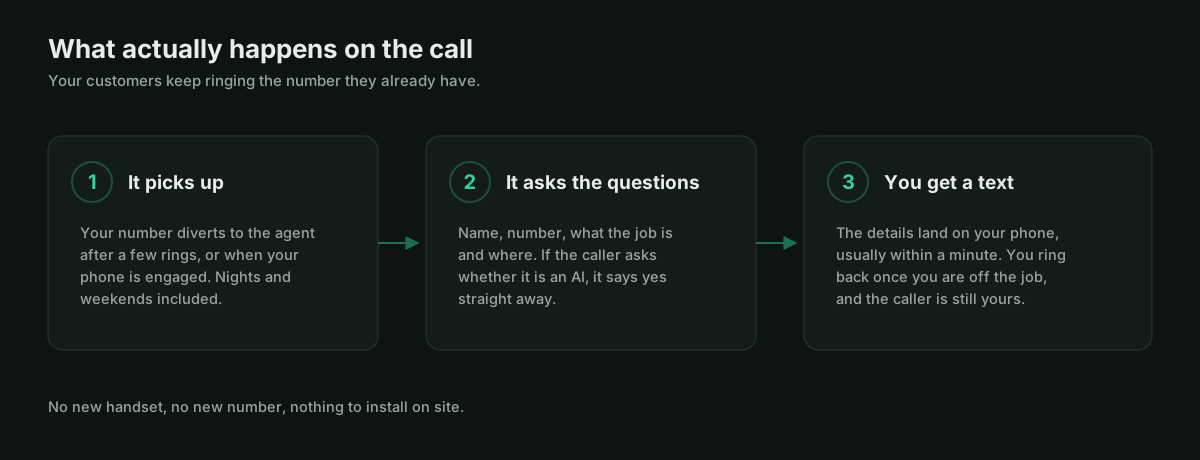
You keep your number. The number on your van, your website and your Google listing doesn't change. Your phone diverts the calls you don't answer, after however many rings you choose, and Pulsemint picks up instead of voicemail. Most UK networks let you set that divert in a couple of minutes, and I'll walk you through it for yours.
The setup itself takes about ten minutes of your time. I ask what you cover, which areas you work in, what you never want it to say, and what counts as urgent for you. Then I build the agent and you ring it yourself to test it before a single customer hears it.
If anything ever goes wrong at our end, the divert fails safe: calls ring your mobile exactly as they do today. You're never worse off than you are now.
Common questions
Can it tell a power cut from a fault?
It asks whether the neighbours have lost power too. If they have, it tells the caller to ring 105, the national power cut number, and lets you know in the summary so you don't waste a callback.
What does it say if someone smells burning?
Whatever you decide when we set it up. Most electricians have it tell the caller to switch off at the main switch if it's safe to do so, and mark the call urgent so the text reaches you first.
Can it handle EICR enquiries from letting agents?
Yes. It takes the number of properties, postcodes, expiry dates, access arrangements and who pays, so you can quote without ringing back to ask.
Will it say I'm NICEIC or NAPIT registered?
Yes, if you are and you want it to. It won't answer detailed regulatory questions, such as whether a job is notifiable, and leaves those for you.
Does it work at evenings and weekends?
Yes, at the same price. A lot of homeowners only ring about quotes in the evening, after work.
Do I have to change my number?
No. Calls you don't answer divert to Pulsemint, and your existing number stays on everything.
Who is behind this
I'm Shadman, and I build and run Pulsemint myself from Lowestoft. When you start the pilot, I set the agent up for your business and you deal with me directly, not a support queue. If it doesn't catch jobs you'd otherwise have lost, don't keep it.