Virtual receptionist for sole traders
Pulsemint is a virtual receptionist for sole traders. It answers your phone in your business name when you can't, takes the caller's name, number, address and what they need, and texts you the details within about a minute. You get a receptionist's job done for £199 a month, without hiring anyone. It costs £199 a month including up to 50 captured calls, and you can try it free for 14 days with no contract.
When you work on your own, you're the boss, the worker and the receptionist. This page covers what a virtual receptionist actually does, what it costs compared with the alternatives, and when you don't need one at all.
Pulsemint at a glance
- What it does
- Answers the calls you miss, takes the caller's details and the job, and texts you a summary within about a minute
- Price
- £199 a month including up to 50 captured calls
- Free trial
- 14 day pilot, no card needed
- Contract
- None. Cancel any time.
- Hours
- Every hour of every day, same price
- Your number
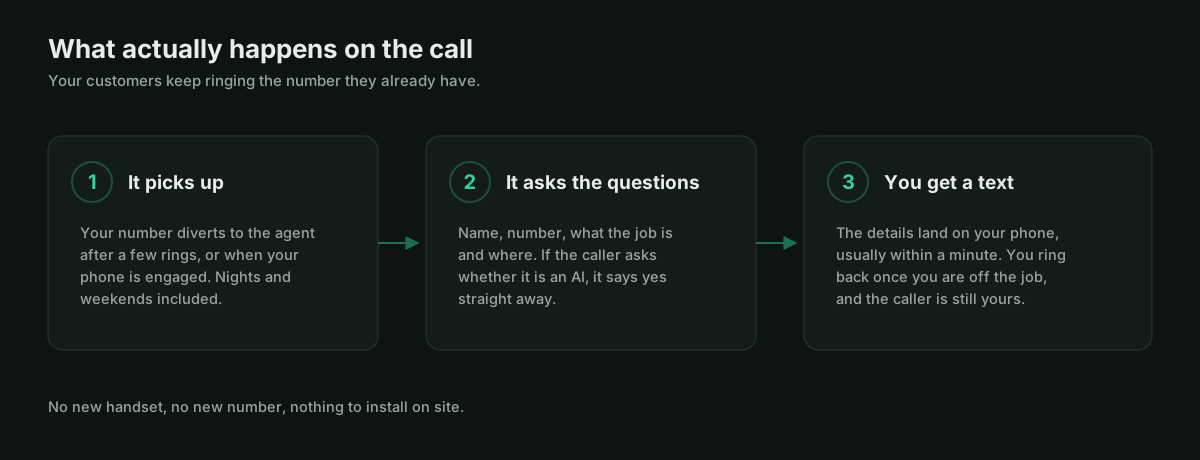
- Stays the same. Unanswered calls divert to Pulsemint.
- Setup
- Done for you, about ten minutes of your time
- Coverage
- Anywhere in the UK
Try Pulsemint free for 14 days
Leave your name and email, then pick a time for a 15 minute setup call. No card and no contract. You keep your number.
Want to hear it first? Talk to the agent now. It answers questions about Pulsemint itself, and nobody will ring you back.
The one person business problem
When you work alone, every call that comes in while you're working is a choice between two bad options. Stop what you're doing and answer, or carry on and hope they leave a message. Most don't. They ring the next person.
A bigger firm solves this with someone in the office. You can't justify a salary just to answer the phone, and you probably don't want the hassle of employing someone either.
What a virtual receptionist does
A virtual receptionist does the part of a receptionist's job that matters most to a sole trader: answering the phone properly and making sure nothing gets lost.
- Answers in your business name, not a generic greeting
- Takes the caller's name, number, address and what they need
- Asks the questions you'd ask, set up for your trade
- Tells them you'll ring back, and when
- Texts you a summary within about a minute
It doesn't do the things that need you. It won't quote, book jobs into your diary, chase invoices or deal with complaints. Those still need a person, and that person is you.
What it costs compared with the alternatives
| Option | Typical cost | What you get |
|---|---|---|
| Hiring part time | Well over £1,000 a month for 20 hours at minimum wage, before holiday pay and employer costs | A real person for set hours. Nothing outside them. |
| Human virtual receptionist | From around £45 a month for a small call allowance, rising with volume | Real people, better with difficult calls. Out of hours often costs more. |
| Pulsemint | £199 a month including up to 50 captured calls | AI agent, any hour, same price. Set up for you. |
| Voicemail | Free | Most callers won't leave a message. |
If you get a handful of calls a week and most callers do leave messages, voicemail and missed call text back are probably enough. The full comparison of paid options, with real prices, is here.
Will it make you look bigger than you are?
It'll make you look organised, which is better. It answers in your business name and deals with callers politely, but it doesn't pretend to be a team of staff. If someone asks whether they're talking to an AI, it says yes.
Most customers don't mind at all. What they mind is ringing three numbers and getting three voicemails. A sole trader who answers every call, even through an assistant, and rings back within the hour comes across as more reliable than a bigger firm that doesn't.
What a call looks like
A sole trader painter and decorator is halfway through cutting in a ceiling. A call comes in from someone who wants three bedrooms and a hallway painted before Christmas.
NEW ENQUIRY. Paint 3 bedrooms and hallway, walls and ceilings, before Christmas. Empty house, can give access any weekday. Liz, 07700 900921, 12 Example Grove, DN4 5AB. Happy for you to ring after 5.
The painter finishes the ceiling, rings back at ten past five, and books the job.
Does it pay for itself?
Use your own numbers, not anybody's industry statistics. Open your phone and count last week's missed calls. Take out the suppliers, the spam and the people who rang back later. Be realistic about how many of the rest you'd have won, then multiply by what a job is worth to you.
As a sole trader, every job you lose is income you don't get back. If you miss six calls a week, two are real jobs and you'd win one, at £200 a job that's around £850 a month. If your missed calls are mostly suppliers and spam, save your money.
If the sum comes out small, you probably don't need an answering service. A better voicemail greeting and missed call text back will do. I'd rather you knew that before you sign up for anything. If you want to put your own figures in, the calculator on the Pulsemint homepage does the sum for you.
Setting it up
You keep your number. The number on your van, your website and your Google listing doesn't change. Your phone diverts the calls you don't answer, after however many rings you choose, and Pulsemint picks up instead of voicemail. Most UK networks let you set that divert in a couple of minutes, and I'll walk you through it for yours.
The setup itself takes about ten minutes of your time. I ask what you cover, which areas you work in, what you never want it to say, and what counts as urgent for you. Then I build the agent and you ring it yourself to test it before a single customer hears it.
If anything ever goes wrong at our end, the divert fails safe: calls ring your mobile exactly as they do today. You're never worse off than you are now.
Common questions
What's the difference between a virtual receptionist and an answering service?
Not much in practice. Both answer your phone when you can't and pass on the details. A virtual receptionist usually means it answers in your business name and is set up around how you work, which is what Pulsemint does.
Is it cheaper than hiring someone?
Much cheaper. A part time receptionist for 20 hours a week costs well over £1,000 a month at minimum wage before employer costs. Pulsemint is £199 a month and covers every hour.
Can it book jobs into my diary?
No. It takes the details and tells the caller you'll ring back. You stay in charge of your own diary.
Will callers know it's an AI?
If they ask, it tells them straight away. It answers in your business name and takes messages politely, which is what most callers want.
Do I need to be a limited company?
No. It works the same for sole traders, partnerships and limited companies.
What if I hardly get any calls?
Then you may not need it. A clear voicemail greeting and missed call text back cost nothing and might be enough. Try the calculator on the homepage first.
Who is behind this
I'm Shadman, and I build and run Pulsemint myself from Lowestoft. When you start the pilot, I set the agent up for your business and you deal with me directly, not a support queue. If it doesn't catch jobs you'd otherwise have lost, don't keep it.