Answering service for gas and heating engineers
Pulsemint is an answering service for gas and heating engineers. When a boiler breakdown call comes in and you're on a job, it answers, takes the boiler make, any fault code and the pressure reading, checks whether anyone vulnerable is in the house, and texts you the details within about a minute. It costs £199 a month including up to 50 captured calls, and you can try it free for 14 days with no contract.
Heating work has the most seasonal call pattern of any trade. This page covers what the agent asks on a heating call, how it handles a reported gas smell, and how it helps through the winter rush.
Pulsemint at a glance
- What it does
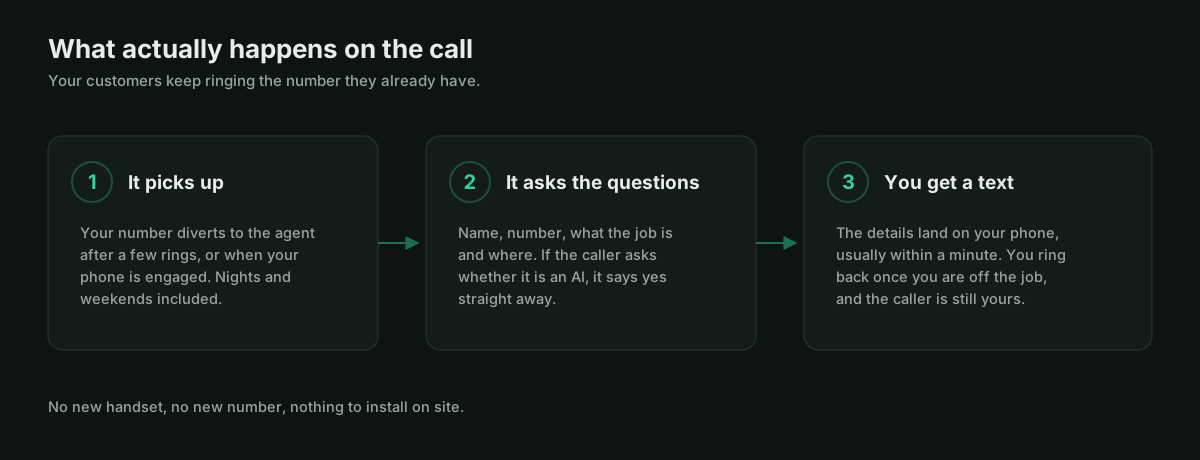
- Answers the calls you miss, takes the caller's details and the job, and texts you a summary within about a minute
- Price
- £199 a month including up to 50 captured calls
- Free trial
- 14 day pilot, no card needed
- Contract
- None. Cancel any time.
- Hours
- Every hour of every day, same price
- Your number
- Stays the same. Unanswered calls divert to Pulsemint.
- Setup
- Done for you, about ten minutes of your time
- Coverage
- Anywhere in the UK
Try Pulsemint free for 14 days
Leave your name and email, then pick a time for a 15 minute setup call. No card and no contract. You keep your number.
Want to hear it first? Talk to the agent now. It answers questions about Pulsemint itself, and nobody will ring you back.
The winter problem
For most of the year, heating calls come in at a steady rate: services, the odd breakdown, a few quotes for new boilers. Then the first properly cold week arrives, everyone turns their heating on for the first time since spring, and the boilers that have been quietly failing all summer stop working at once.
That's the week you're busiest and least able to answer. It's also the week customers ring three engineers in a row, because they've got no heating and nobody wants to wait. The engineer who answers, or rings back within a few minutes, gets the job.
What Pulsemint asks on a heating call
Details that tell you what you're walking into
- The boiler make and model if they know it, such as Worcester Bosch, Vaillant, Baxi or Ideal
- Any fault code showing on the display. A code often tells you before you arrive whether you'll need a part. An F28 on a Vaillant, for example, points you at ignition.
- What the pressure gauge reads. Under about 1 bar, it may only need repressurising, and you might sort it with a quick call instead of a visit.
- Whether it's no heating, no hot water or both, and whether it's a combi or a system with a cylinder
- How old the boiler is and when it was last serviced
Who's in the house
It asks whether anyone elderly, unwell or very young is at home without heating. Those calls get marked urgent so they reach you first.
If they smell gas
This is the one thing the agent never treats as routine. If a caller mentions a gas smell, it tells them to ring the National Gas Emergency Service on 0800 111 999 straight away, open windows, and not use switches or flames. Then it passes the details to you. That's what you'd tell them yourself, and it shouldn't wait for a callback.
What it won't do
It won't quote a price, promise a date or agree to anything on your behalf. Those are your decisions, and an agent that guesses at them creates problems. It tells the caller you'll ring them back, and if someone asks whether they're talking to an AI, it says yes straight away.
What a call looks like
A man rings at 7.15am on a cold Tuesday. His mother's boiler has stopped and she's 84. The display shows F28. He doesn't know the pressure, so the agent asks him to look at the gauge on the front: it says 1.4.
URGENT, VULNERABLE. No heating or hot water, 84 year old at home. Vaillant ecoTEC, shows F28, pressure 1.4 bar. Son David, 07700 900173. Address 22 Example Close, PE2 6XY. Mum is in all day.
You can see from the text that it's probably ignition, the pressure's fine, and it's a priority. You ring back from your van knowing which part to check you've got.
Landlord gas safety records and servicing
Not every call is a breakdown. Landlords need a gas safety check every year, and letting agents ring to book them in batches. Homeowners ring in spring and summer to book a service. Those calls are easy to lose because they aren't urgent, so the customer simply books whoever answers.
The agent takes the number of properties, the address of each, when the current record expires and how to arrange access. If callers ask whether you're Gas Safe registered, it can give them your registration number so they can check it.
Does it pay for itself?
Use your own numbers, not anybody's industry statistics. Open your phone and count last week's missed calls. Take out the suppliers, the spam and the people who rang back later. Be realistic about how many of the rest you'd have won, then multiply by what a job is worth to you.
A new boiler installation is usually worth thousands, and most of them start with a breakdown call from someone whose old boiler has finally given up. If missed winter calls cost you even one installation a year, Pulsemint has paid for itself several times over.
If the sum comes out small, you probably don't need an answering service. A better voicemail greeting and missed call text back will do. I'd rather you knew that before you sign up for anything. If you want to put your own figures in, the calculator on the Pulsemint homepage does the sum for you.
Setting it up
You keep your number. The number on your van, your website and your Google listing doesn't change. Your phone diverts the calls you don't answer, after however many rings you choose, and Pulsemint picks up instead of voicemail. Most UK networks let you set that divert in a couple of minutes, and I'll walk you through it for yours.
The setup itself takes about ten minutes of your time. I ask what you cover, which areas you work in, what you never want it to say, and what counts as urgent for you. Then I build the agent and you ring it yourself to test it before a single customer hears it.
If anything ever goes wrong at our end, the divert fails safe: calls ring your mobile exactly as they do today. You're never worse off than you are now.
Common questions
What happens if a caller says they smell gas?
The agent tells them to ring the National Gas Emergency Service on 0800 111 999 straight away, open windows and avoid switches and flames. Then it texts you the details. It never treats a gas smell as a routine callback.
Can it ask for the fault code?
Yes. It asks what the display shows and what the pressure gauge reads, which often tells you before you arrive whether you'll need a part or just a repressurise.
Will it prioritise vulnerable customers?
Yes. It asks whether anyone elderly, unwell or very young is at home without heating, and marks those calls urgent.
Can it give out my Gas Safe number?
Yes, if you want it to. Customers can then check you on the Gas Safe Register before you arrive.
Does it handle landlord gas safety bookings?
Yes. It takes the number of properties, addresses, expiry dates and access arrangements for each.
Is there a winter surcharge?
No. It's the same £199 a month whatever the season, including evenings and weekends.
Who is behind this
I'm Shadman, and I build and run Pulsemint myself from Lowestoft. When you start the pilot, I set the agent up for your business and you deal with me directly, not a support queue. If it doesn't catch jobs you'd otherwise have lost, don't keep it.